Your clinic keeps every record. It just can't tell you anything.
Who is waiting. What today took. Whether the patient you saw in March ever came back. The answers are already inside your clinic — in the cabinet, in the diary, in the pile of notes counted at night. Zimam is that same record, made legible.
Running in a clinic today, not a roadmap. Everything described on this page is in the product now. If something is not live yet, it does not appear here until it is.
Four costs you are already paying.
Not one of them appears anywhere in the clinic. That is exactly why they keep being paid.
On paper they are not a number, they are an absence. One patient a week who would have returned is fifty-two visits a year — work you had already earned the right to, and never billed. Nothing in the clinic counts an absence.
Insured work done in July, still uncollected in October. Not refused — simply never claimed. No insurance company reminds you of money it has not been asked for.
At the end of the day the centre's notes and yours are the same pile. Every split becomes a conversation — and a conversation is not evidence.
Nobody at the desk knows they have been sitting fifty minutes. You learn it from them, in the room — and by then that wait is what they tell the next person who asks about your clinic.
Nothing is missing. Nothing is legible.
It is all written down already. Every visit, every payment, every note the clinic has ever taken — kept, and none of it thrown away.
But a pile is not a record. Nothing in it can be counted, sorted, or checked against anything else. Every answer has to be assembled by hand, by somebody, in an evening — so most of the questions worth asking never get asked at all.
The same paper, put in an order. Not more work at the desk — the same day, written down once, where a question can reach it.
The same day, written down once.
Nothing here asks the clinic to work differently. Reception books, the patient arrives, you see them, they pay. The difference is that each of those moments is now recorded by the person doing it — and everything else falls out of that on its own.
Opens in the browser on any phone, tablet or computer, and saves to the home screen like an app.
Every patient is held in both scripts and found by part of a name in either. The screens themselves are in English.
Reception books, registers and takes payment, and never sees a total or a report. The owner sees all of it. Enforced on the server, not hidden in a menu.
The doctor's phone view still opens and still shows this morning's list, stamped with the time it last reached the server.
The working thing, not a mock-up.
Two screens, and deliberately the ones with nobody on them: registering a patient, and setting up a clinic’s week. We will not put another clinic’s patients on a marketing page, and a demo record with a plausible name beside a file number is close enough to one that it does not belong here either. The rest of Zimam you see on a call, on your own screen, with your own clinic in it.
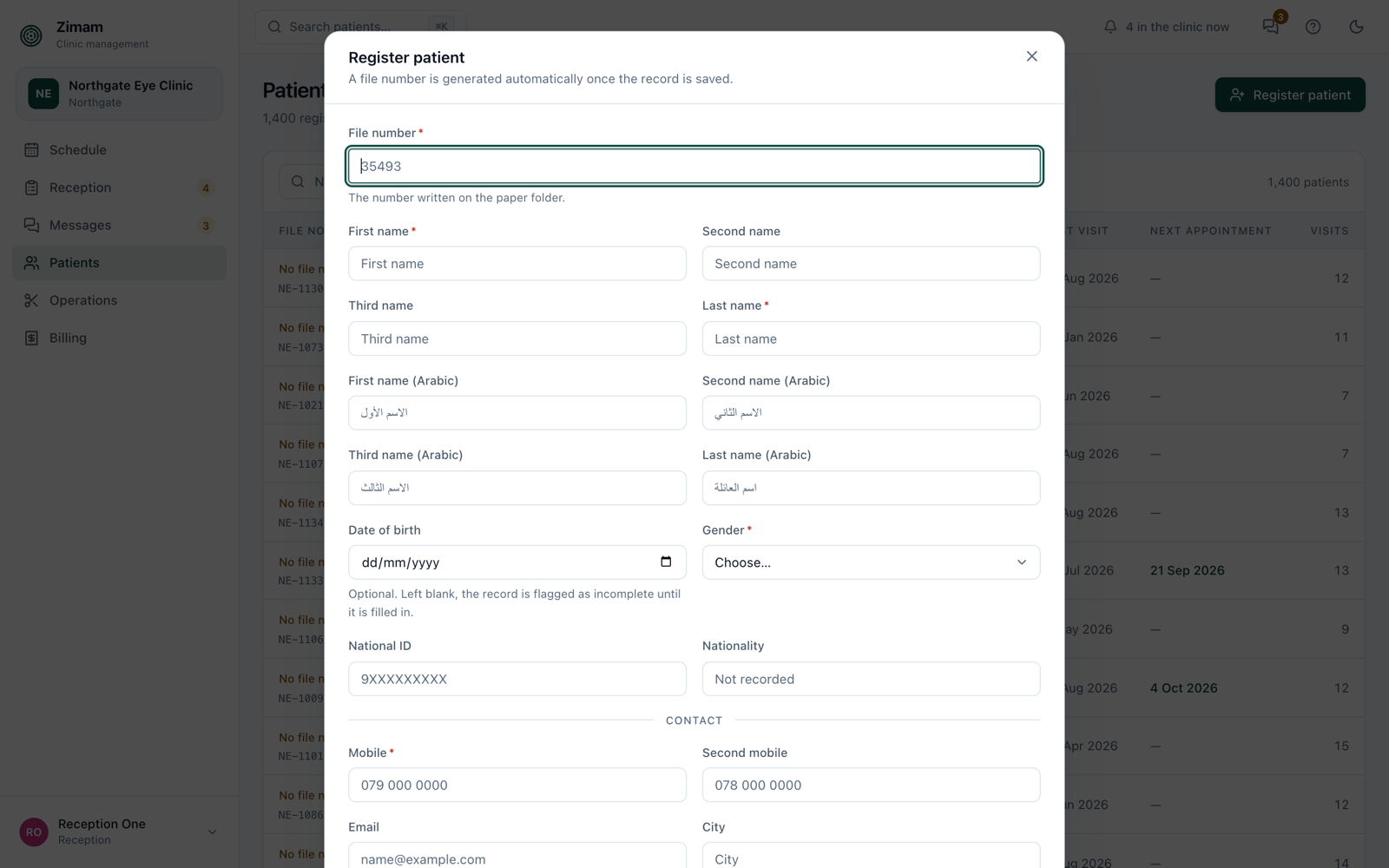
The number written on the paper folder, then the name in English and in Arabic — four parts each, because that is how a name is actually written here and a single “full name” box loses it.
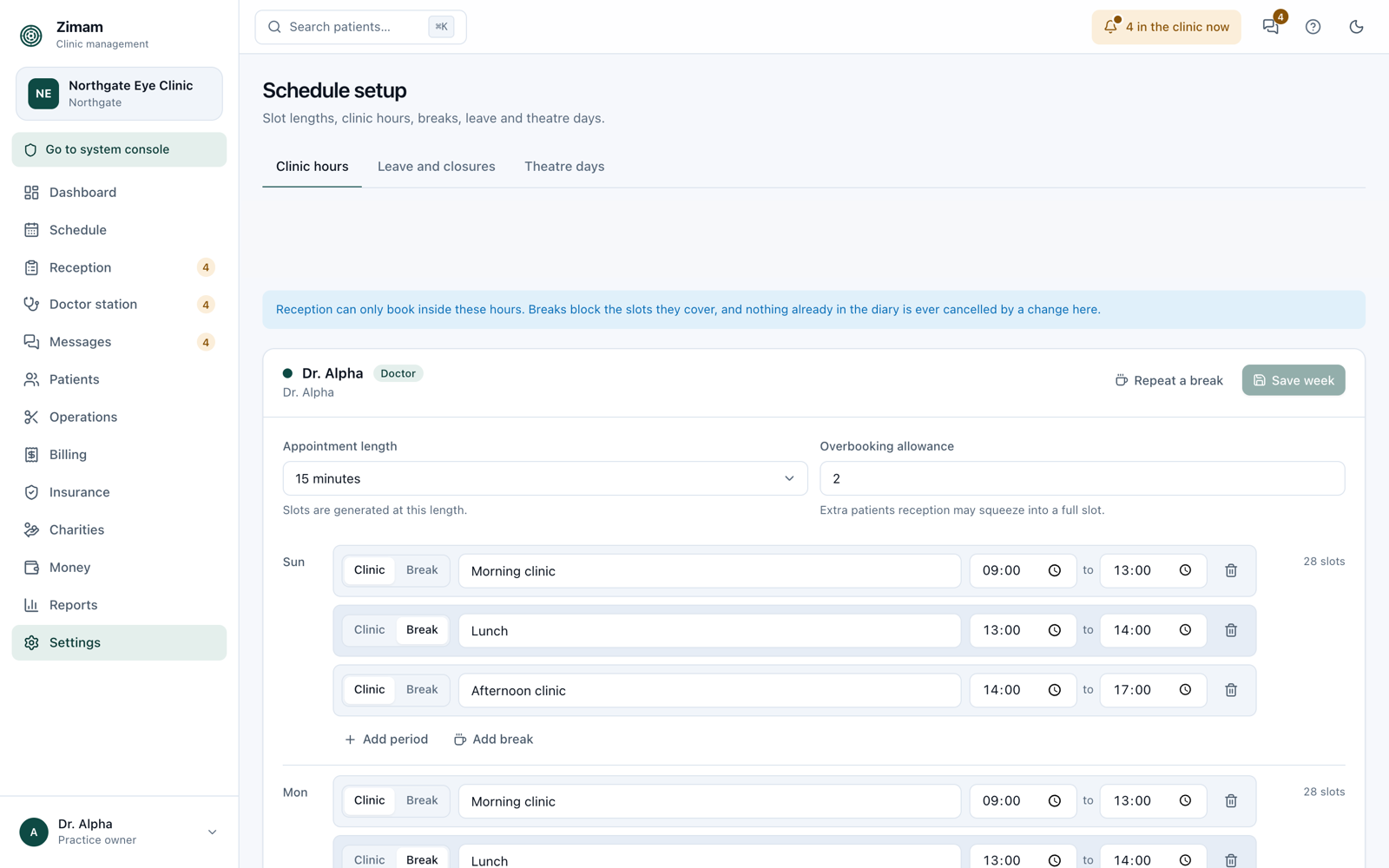
Clinic periods, breaks, leave and theatre days. Reception can only book inside these hours, and nothing already in the diary is cancelled by a change here.
One patient. The same day, twice.
Nobody works differently. The same five moments happen in the same order. The difference is whether each one is written down where the next one can reach it — and what is left at the end of the day because it was not.
- Bookedthe desk takes the appointment
- Arriveschecked in, and the clock starts
- Seenexamined, and the orders written
- Orderedtests, glasses, a procedure
- Billedpaid at the desk, or claimed
A bill made of what reception could reconstruct, a wait you hear about as a complaint, and insured work sitting on no claim at all. Nothing was stolen. It was never written down.
A bill that is exactly what was ordered, a wait you can see in minutes, and a claim that has already left with its own number and a due date. The same day. Nothing fell off it.
One visit. Everything it feeds.
The reason a clinic platform is worth having is not that it stores the visit. It is that the visit is the only thing anybody types. Everything underneath falls out of it — already priced, already claimable, already counted.
- ArrivalFound by name in Arabic or English, or by mobile. The wait starts counting.
- Examination roomThe room fills only the fields it has been given. The doctor is not waiting on it.
- The doctorThe speciality’s own sheet, saving as he writes, with an amendment trail once released.
Nothing below is typed again.
And underneath all of it, the audit trail. Who did what, to which record, and when — including what was changed after it was released.
This is the argument for a platform rather than five separate habits. A diary that does not know the price, a receipt book that does not know the diagnosis and a notebook that does not know either are not a clinic system — they are the same visit written down three times, and the third time is where it stops matching.
Money leaves a clinic two ways.
One is cash that was taken and cannot be accounted for. The other is work that was done and never claimed. They are different problems, and Zimam treats them as two.
Whoever takes the money does not get to add it up.
Reception collects; the owner reconciles. That is not a rank — it is a separation of duties, and it is the reason a shortfall has somewhere to show up.
Reception must find the patient first. No invoice appears until they do. They cannot browse the ledger, discount, void an invoice or close the day.
Reception never sees a total. Not the day's, not the month's, not a single report. Someone who does not know what the till should hold cannot quietly account for what is missing.
The owner sees expected against counted. What the system recorded, beside what was counted in the till — with a breakdown of who took which payment.
All of it enforced on the server. The interface does not merely hide the screens; the system refuses the request.
Insurance is not a billing problem. It is a memory problem.
Work is done in July, claimed in August, half paid in October — and by then nobody can say which lines were cut, or why. Zimam runs it as a reconciliation desk.
Priced before the work. The insurer's own price list is loaded, so cover is on screen before the patient stands up — and an expired policy says so, in colour, before anything is charged to a company that will not pay.
Claimed without retyping. The month's insured visits are gathered into one claim, built from the invoices rather than re-keyed, and it leaves with its own number and a due date.
Settled line by line. Approved, partial or rejected — per line, not as a lump sum. A rejection you can see is a rejection you can appeal.
Overdue surfaces itself. Each insurer has its own settlement days. Anything past due is flagged the morning it goes past due — including insured work sitting on no claim at all.
Agreed once. Billed once. Paid over months.
Some work is not one visit. It is six, across a season, agreed in one conversation while the patient is still in the chair — and then remembered wrongly by everyone, because the only record of it was that conversation.
Each step named from the clinic’s own price list or typed by hand, with a price and a rough date. While it is a draft it bills nothing and books nothing.
A single invoice for the agreed total, in the clinic’s ordinary ledger — with the instalments the patient agreed set against it. The schedule has to add up before the plan can start: the screen shows the shortfall as you type, and the server refuses it again on arrival.
A follow-up list of every running course — what is still owed, what is overdue, most overdue first — and she records the payment from the plan itself, as an ordinary payment against that one bill.
What each instalment has been met by is worked out from the payments actually recorded against the plan’s bill, oldest first. So the doctor who wrote the course and the receptionist who collects it open different screens and read the same number — and correcting a receipt corrects the schedule with it, instead of leaving it lying.
Every dated step is filed as a request, and nothing reaches the diary until someone at the desk approves it — because the person who rings the patient is the one who knows what time actually suits. A step left undated proposes nothing at all.
Being behind never blocks a booking. There is no payment check anywhere on the booking path. The front desk sees what the patient owes and books the appointment anyway. A clinic should not have to hold a debt argument with someone in its own waiting room.
Starting, completing and cancelling a course belong to the doctor. The front desk is never shown those buttons, and the server refuses the request even if it is sent directly. And once any money has been taken, the course cannot be cancelled at all — Zimam asks for a refund on the bill first, so a paid-for course never quietly disappears.
What is not finished, said plainly. Zimam does not yet mark the individual steps of a course as done, so it will tell you what is owed but not how far through the treatment you are. A course does not yet appear in the reports, in the data export, or as a printed plan for the patient to take away, and a plan’s bill cannot be put through insurance. It is in the product for every clinic and every speciality — there is no switch to turn on.
You cannot fix a number you have never been shown.
Three answers first — not new reports, but questions no clinic running on paper has ever been able to put.
Timed from the moment reception checks them in to the moment the chart is opened. Not remembered afterwards — recorded, every visit.
The patients seen once and never again, counted — against the ones who return five times. A number you can act on.
Visits, revenue and time per patient, separated by doctor — so a share is a calculation rather than a conversation.
A day, a week, thirty or ninety days, a year to date — or two dates you pick yourself.
On the overview, each headline figure carries its change against the period immediately before.
Click a headline figure and it opens the rows behind it — the patients themselves, not another summary.
Every report screen prints as it stands, so a figure can leave the building as paper without being copied out by hand.
The clinic is the same. Only the examination changes.
Patients, diary, reception board, billing, insurance, roles and the audit trail have nothing speciality-specific in them at all — they run for any clinic exactly as they stand. The one part that changes is the examination sheet. Every speciality below ships with its own — and what you see under each one is the sheet itself, group by group, as it is written in the product.
Your examination sheet
Ophthalmology
What is not finished, said plainly. Ophthalmology is the sheet built and proven in a working clinic, because an eye clinic is where Zimam was built. The rest ship on the same machinery, and the product marks a sheet inside the clinic until a doctor of that speciality has been through it with us. Outside ophthalmology, recorded findings stay in the consultation — they do not yet reach printed documents or the data export. You will be told which of these applies to you before you plan anything around it.
What the first fourteen days actually look like.
Counted from the day you go live, not the day you sign.
Your files, your services and your insurance price lists are carried across for you. Nobody on your side types them in, and nobody is asked to run two systems in parallel while it happens.
Your own patients and your own day, running through it, before you commit to anything. If it does not fit the clinic you run, you stop inside those fourteen days and take your records with you.
Reception, the room and the accounts all work in the same place. There is no separate edition that holds the reports, and no part of what is on this page is switched off to begin with.
Thirty days notice, in writing, at any time. Your records leave with you — exported in full, in a format you can open. This is the same rule as every other piece of work we do.
Not a manual and a login. The people at the desk and the people in the room are taken through the screens they will actually use, on your own clinic’s data.
Support comes from the people who build and run Zimam, in Arabic or English — not a ticket queue, and not a script.
A platform, or a build of your own.
Adopting something finished and commissioning something new are different decisions, and the honest answer is often the first one.
If your clinic works the way most clinics work.
You are adopting something finished. The work is configuration and training rather than design and build — and you watch it running on your own patients before you decide anything.
If what you run is genuinely different.
Forcing your work into someone else's software takes more out of you than building for it. That is what applications & solutions is for — and you will hear that rather than be pushed onto the platform.
Thirty minutes, and nothing is pitched.
We open it on your own kind of day and you decide what you are looking at. If Zimam is not the right fit for the clinic you run, that is what you will be told — the same as on any other call.
Tell us how many doctors and rooms you run and what you treat, and you get a figure for your clinic rather than a rate card. A person reads it, normally within one working day.